


Origin Real Estate Credit Fund
A multifamily real estate credit strategy with the objective of maximizing current income and preserving investor capital.
OVERVIEW
Fund Highlights
The Fund focuses exclusively on lending to apartment communities in growing markets—assets that tend to remain resilient across market cycles. By combining publicly traded bonds with privately originated loans, the portfolio provides diversified exposure to multifamily credit while aiming to deliver consistent cash flow and stability. The Fund is broadly available to investors without accreditation requirements, and repurchase offers are made on a quarterly basis.
Total Equity
$367M (as of 1/15/2026)
Fund Structure
Interval
Eligibility
No restrictions
Minimum
$5K (Class I)
Distributions
Monthly
Tax Reporting
1099
Ticker (Class I)
ORRIX
Key Features

Current Income
Targets income-producing multifamily credit for steady cash flow across market cycles.

Portfolio Diversification
Combines public and private credit to reduce correlation with stocks and traditional bonds.

Multifamily-Centric
Invests in multifamily-centric securitized credit and originates loans secured by multifamily properties.

REIT Structure
REIT pass-through allows investors to take a 20% federal tax deduction on qualifying distributions.
STRATEGY
Current Portfolio
The portfolio is a mix of securitized credit and direct lending. By blending institutional bonds with carefully selected real estate loans, the Fund aims to generate consistent income with diversified credit exposure.
Securitized Credit
Pools of fixed and floating rate first-lien multifamily-centric loans originated by Freddie Mac and other lenders.
Direct Lending
Privately originated senior and mezzanine-level financing provided to multifamily real estate projects.
Cash
Cash reserves.
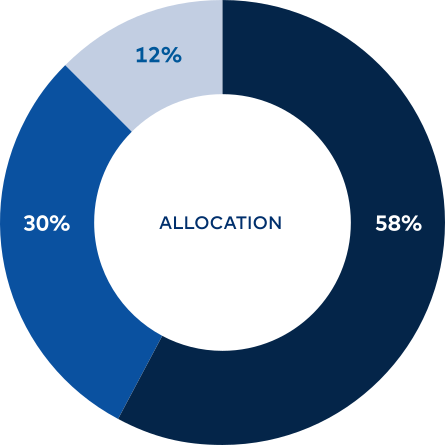
As of 1/15/2026. Allocation shown as percentage of net assets and holdings are subject to change. Current and future portfolio holdings are subject to risk.
STRATEGY
Why private real estate credit now?
A combination of supply constraints and capital shifts is influencing the multifamily credit landscape. We believe these market conditions create a compelling environment for this strategy.
Scale of the Market
According to Newmark research, $1.7T in multifamily debt will mature between 2024 and 2033. This points to a massive opportunity in the lending market.1
Scarcity of Capital
Banks are likely to scale back commercial real estate lending in the coming years, limiting credit availability and creating opportunities for non-bank lenders, Newmark reports.2
Supply and Demand Imbalance
RealPage data shows that three times as many units were absorbed as were built in 2025, pointing to a massive shortfall in supply.3
1) Source: Newmark, U.S. Capital Markets Report, Q2 2024. 2) Source: Federal Reserve Senior Loan Officer Opinion Survey, April 2024; CBRE U.S. Capital Markets Snapshot, Q1 2024. 3) Source: RealPage Market Intelligence, U.S. Multifamily Supply & Demand Trends, June 2024.
STRATEGY
Why multifamily real estate—and why now?
Housing is a basic human need, making this asset class resistant to disruption. Historically, multifamily real estate has delivered strong returns with less volatility than other property types.4 But what makes now a compelling time to invest?
A persistent housing shortage and resilient demand support rent growth potential.
Multifamily assets can potentially generate stable, recurring income through contractual rent payments.
Short-term leases allow for frequent rent adjustments, helping to keep pace with inflation.

4) Source: National Council of Real Estate Investment Fiduciaries (NCREIF) Property Index. Represents average annualized unlevered returns for private commercial real estate from 1/1/1990 to 12/31/2024. The NCREIF Property Index (NPI) is a quarterly, unleveraged composite total return for institutionally held private properties. Investors cannot invest directly in an index, and unmanaged index returns do not reflect fees, expenses or sales charges.
Resources
Review the literature on the fund below.
Ready to invest?
Important Risk Information
Consider the investment objectives, risks, and charges and expenses of the fund carefully before investing. The prospectus contains this and other information about the fund and may be obtained by calling 833-446-9060. The prospectus should be read carefully before investing. The fund is distributed by Ultimus Fund Distributors, LLC. Origin Credit Advisers, LLC and Ultimus Fund Distributors, LLC are not affiliated.
Investing involves risk, including loss of principal. The value of the fund’s shares, when redeemed, may be worth more or less than their original cost. The Origin Real Estate Credit Fund is a continuously-offered, non-diversified, registered closed-end fund with limited liquidity. Shareholders should consider Shares of the Fund to be an illiquid investment appropriate only as a long-term investment. Shareholders should look to the Fund’s quarterly repurchase offers as their sole means of liquidating their investment, which may be limited as described in the Fund’s prospectus. The Fund is non-diversified and concentrates its investments in the real estate industry. The Fund’s concentration in the commercial real estate industry may increase the volatility of the Fund’s returns and may also expose the Fund to the risk of economic downturns in this industry to a greater extent than if its portfolio also included investments in other industries. The Fund will invest in mortgage-backed securities, such as mortgage pass-through securities, which have different risk characteristics than traditional debt securities. Certain mortgage-backed securities may be more volatile and less liquid than other traditional types of debt securities. There is a risk that issuers and counterparties will not make payments on securities and other investments held by the Fund, resulting in losses to the Fund. Fixed income investments are affected by a number of risks, including fluctuation in interest rates, credit risk, and prepayment risk. In general, as prevailing interest rates rise, fixed income prices will fall. The Fund may invest, directly or indirectly, in “junk bonds.” Such securities are speculative investments that carry greater risks than higher quality debt securities. Leverage may increase the risk of loss and cause fluctuations in the market value of the Fund’s portfolio to have disproportionately large effects or cause the NAV of the Fund generally to decline faster than it would otherwise. There are risks associated with REITs. Risks include declines from deteriorating economic conditions, changes in the value of the underlying property, and defaults by borrowers.
Definitions
Securitized Credit
Debt that has been bundled into bonds and sold to investors—typically backed by loans such as mortgages or commercial real estate debt.
Freddie Mac
A U.S. government–sponsored enterprise that buys mortgages, bundles them into securities, and guarantees payments to investors—especially active in multifamily lending.
Freddie Mac K Bonds
Securities backed by pools of Freddie Mac multifamily loans, sold in tranches with different levels of risk and return.
K-Deal B-Pieces
The risk-retention bonds in Freddie Mac’s multifamily securitizations; B-piece buyers take the first losses in exchange for higher potential returns.
Interest Only Strips (IO Strips)
Securities that entitle the investor only to the interest payments from a pool of loans, not principal repayments.
Credit-Risk Transfer Certificates (CRT)
Bonds issued by agencies like Fannie Mae or Freddie Mac that transfer a portion of mortgage credit risk to private investors.
Senior Loans
Loans that have first claim on a borrower’s assets and cash flow; they get repaid before other, more junior debt.
Mezzanine Loans
Subordinate loans that sit between senior debt and equity; they pay higher interest because they take more risk.
Fixed Rate Loans
Loans with an interest rate that stays the same for the entire term.
Floating Rate Loans
Loans whose interest rate adjusts over time based on a benchmark like SOFR.
SOFR Interest Rate Caps
A contract that limits how high the SOFR benchmark rate can rise on a floating-rate loan, protecting the borrower from extreme increases.
Hedged Floating Rate Loans
Floating-rate loans where the borrower uses tools like interest rate caps or swaps to limit rate volatility.
Standard Deviation
A measure of how much values (or investment returns) vary from their average; higher standard deviation means greater volatility.
Unrelated Business Taxable Income (UBTI)
Taxable income earned by a tax-exempt entity from activities not related to its core exempt purpose.
Loan-to-Value (LTV)
The ratio of a loan amount to a property’s value, expressed as a percentage; higher LTV means higher lender risk.
Debt-Service Coverage Ratio (DSCR)
A measure of a property’s ability to cover debt payments, calculated as NOI divided by debt service; values above 1.0 indicate stronger coverage.